


Sullivan Dewing 2026 Federal Budget Summary - What the Changes Mean For You
May 2026 Federal Budget Summary
SIGNIFICANT TAX CHANGES
What This Budget Means For You
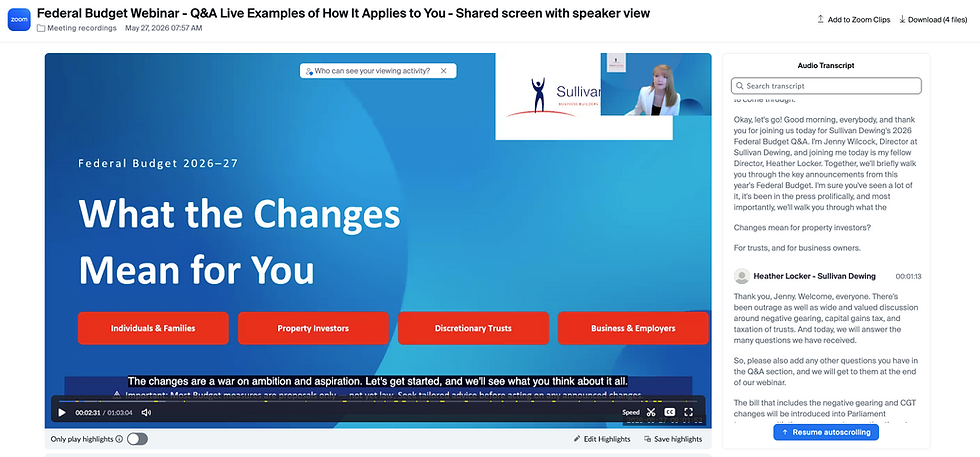
The 2026–27 Federal Budget, handed down by Treasurer Jim Chalmers on 12 May 2026, includes significant tax changes that will impact many of you. There is a strong focus on housing affordability, cost-of-living pressures and supporting broader economic stability. Substantial tax and property-related changes have been proposed, particularly for negative gearing, CGT concessions and taxing discretionary (family) trusts.
Released against a backdrop of ongoing inflation, fuel price increases and higher interest rates, the Budget contains a range of measures that will affect investors, businesses and individuals. There were no new changes to superannuation announced in this budget.
Investors
Limits on Negative Gearing
Properties acquired before 12 May 2026 will be exempt from change and can continue to deduct negative gearing losses against other income. From 7.30pm 12 May 2026:
Residential property purchased after this date will be unable to deduct rental losses against other income
Any losses can be deducted against other rental income or capital gains
If the losses aren’t used, they will be carried forward until they can be deducted against future rental profits or capital gains
These changes don’t apply to commercial property, shares or super funds
Carve Out - From 1 July 2027 existing negative gearing rules will continue to apply to New Builds
New Builds are residential properties which add to the housing supply and include units, houses and duplex construction.
50% CGT Discount and pre-CGT Exemption Scrapped and Replaced by Indexation and Minimum Tax Rate
From 1 July 2027, the 50% CGT discount will be replaced by cost base indexation for assets held for more than 12 months. In addition, a minimum tax rate of 30% will apply to capital gains that accrue after 1 July 2027.
Assets acquired before 20 September 1985 (pre-CGT assets) historically exempt from CGT, will no longer be exempt from 1 July 2027.
Transitional rules will attempt to limit the impact of these changes for existing investments. The existing CGT discount and exemption for pre-CGT assets will continue to apply to gains that accrued before 1 July 2027.
Taxpayers will need to have existing assets valued at 1 July 2027 to enable CGT calculations to be undertaken.
The CGT changes apply to all asset classes, including property and shares. The changes will apply to individuals, trusts and assets held by partnerships.
However, investors in new residential properties will be able to choose to apply either the 50% CGT discount or cost base indexation and the minimum tax.
Minimum Tax on Family Trusts
From 1 July 2028 a 30% tax rate will be applied to profits made by discretionary trusts. The Trustee pays the tax, then passes it on to the beneficiaries of the Trust. Individuals and other non-corporate beneficiaries will receive this non-refundable tax credit for the tax paid by the Trustee.
This means that if the beneficiaries’ tax rate is above 30%, they will pay top up tax, and if it is below 30%, any excess tax credit will be lost and not refunded. The non-refundable credit will not be available for corporate beneficiaries (often referred to as bucket companies), who will end up being taxed twice.
There will be available a limited form of rollover relief for three years from 1 July 2027 for small businesses and others who wish to restructure out of a discretionary trust into a company or fixed trust.
The rollover relief may help to minimise CGT and other income tax implications, but broader issues such as stamp duty will need to be considered before any changes to an existing structure are implemented.
The minimum tax will not apply to fixed and widely held trusts, super funds, special disability trusts, deceased estates and charitable trusts. It will also not apply to discretionary Testamentary Trusts in existence at 12 May 2026, but it will apply to a discretionary Testamentary Trust that is established after this date.
Business and Employers
Instant Asset Write Off
Starting 1 July 2026, the instant asset write-off for small business entities will permanently increase to $20,000.
Eligible small business entities with aggregated turnover of less than $10 million will be able to claim an immediate deduction for the full cost of the depreciating assets costing less than $20,000. The cost threshold applies on an asset-by-asset basis so immediate deduction could potentially apply to multiple assets purchased for less than $20,000 in a particular income year.
FBT on Electric Cars
The Government will progressively reduce the scope of the FBT exemption, as follows:
The FBT exemption will continue to operate in its current form until 31 March 2027
From 1 April 2027 to 31 March 2029 the full FBT exemption will only be available if the car costs <$75,000. Electric cars above this threshold but costing less than the luxury car tax (LCT) threshold for fuel-efficient cars will receive a 25% FBT discount
From 1 April 2029 all electric cars costing less than the LCT threshold will receive a 25% FBT discount
Employees will continue to include a Reportable Fringe Benefit on electric cars in their tax return, even though the employer may be exempt from FBT on the car.
Loss Carry Back for Companies
For income years commencing on or after 1 July 2026 companies with aggregated annual global turnover of <$1 billion will be allowed to carry back a tax loss and offset it against tax paid up to two years earlier. This will only apply to tax losses (not capital losses) and is limited to the company’s franking account balance.
Loss Refunds for Small Start Up Companies
From 1 July 2028, start-up companies with aggregated annual turnover of less than $10 million that generate a tax loss in the first two years of operation will be able to utilise the loss to generate a refundable tax offset.
The offset will be limited to the value of fringe benefits tax paid and withholding tax on wages paid in respect of Australian employees in the loss year.
R&D Tax Incentive
The R&D Tax Incentive will be restructured from 1 July 2028, shifting support towards experimental R&D through higher offset rates, while removing eligibility for supporting activities. Outcomes will vary across the claimant base – younger, innovation-led companies with clearly demonstrable experimental activity are likely to benefit, while more established companies and those relying on supporting R&D activities may see reduced claim values.
The reforms are accompanied by a tightening compliance environment, with increased scrutiny on R&D claims and a greater emphasis on documented, evidence-based substantiation of experimental activity.
PAYG Flexibility for Small and Medium Businesses
Effective 1 July 2027 small and medium businesses will be able to opt into monthly reporting and payment of PAYG instalments.
Temporary Reduction of Fuel Excise and Heavy Vehicle Road User Charge
The government has temporarily reduced the excise and excise-equivalent customs duty rates (excise rates) applying to most fuel products as well as the road user charge for heavy vehicles from 1 April 2026. Excise rates have been reduced by 60.9%, equating to a 32 cent per litre reduction for petrol and diesel. The road user charge for heavy vehicles has also been reduced from 32.4 cents per litre to zero.
Individuals and Families
Working Australians $250 Tax Offset
From 1 July 2027 the government will introduce a $250 Working Australians Tax Offset (WATO). The offset will increase the tax-free threshold for income derived from work by nearly $1,800 to $19,985 (or up to $24,985 for workers eligible for the Low-Income Tax Offset). The WATO will also be available to sole traders.
$1,000 Instant Tax Deduction for Workers
From the 2026-27 tax year onwards, Australian residents will be eligible to claim an instant tax deduction of $1,000 for work related expenses. Charitable donations, union fees and professional association memberships can be claimed on top of the standard deduction. Taxpayers who have incurred more than $1,000 in qualifying work-related expenses can choose to claim actual expenditure instead, but will need to substantiate these expenses.
Income Tax Cuts
Legislation has already been passed to ensure that the 16% tax rate on taxable income between $18,201 and $45,000 will drop to 15%. The rate will then drop to 14% from 1 July 2027.
Conclusion
This year’s Federal Budget introduces significant proposed changes across tax, property and business, many of which have a direct impact on individuals, investors and employers. While some measures create new opportunities, others require careful planning and consideration.
Importantly, most of the measures announced are not yet law and may change as legislation progresses. As always, we recommend reviewing your position early and seeking advice before making any major decisions.
If you would like to discuss how these announcements affect you, your business or structures, please contact your Client Manager.


Comments